
EarnIn: Why Wait for Payday?
Activehours Inc.Finance
4.8141.54K Reviews
- Version
- 16.69
- Installs
- 10.00M
- Age Rating
- Everyone
Screenshots

Our Review of EarnIn: Why Wait for Payday?
 Analysis by Appyee
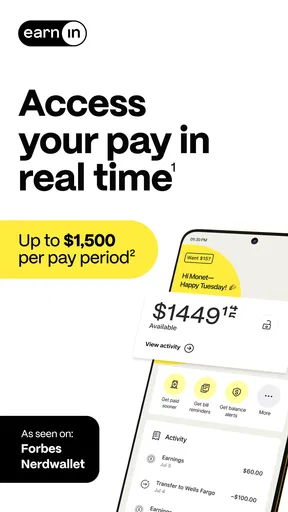
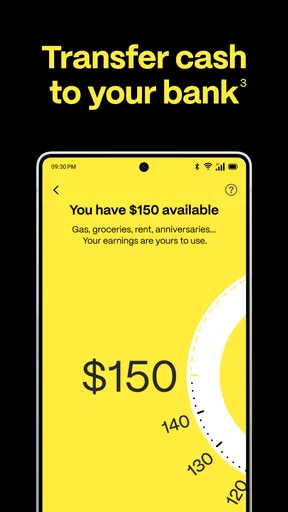
When a household is waiting for payday and a bill arrives early, the problem is often timing rather than a complete lack of income. That is the situation where I found EarnIn most interesting. It is a finance app from Activehours Inc. built around accessing earned pay before the usual payday, with the store summary describing advances of up to $150 a day and a maximum of $1,000 per pay period. I would not treat it as extra money or a long-term budgeting solution, but it can be useful when a short gap needs attention.
My review focuses especially on how it fits into shared household life. A partner may ask whether the app is safe to use, a family member may want help understanding it, or several people may share a phone or tablet. Those situations make account boundaries and trust just as important as the headline feature. The app is free to install, rated for Everyone, and its current version is 16.57 for devices running Android 8.0 or later. Those details make it broadly accessible, but they do not remove the need for careful personal use.
How EarnIn fits into a shared household
When I consider EarnIn in a shared household, I focus on how one person’s early-pay decision can affect bills and plans everyone relies on. I’d agree in advance on a simple way to record the request and its purpose, so the household can plan around the next paycheck without treating personal account access as shared property.
A realistic moment when early access can help
Imagine a household where the main earner has already worked the hours needed for the next paycheck, but the normal payday is still several days away. A grocery trip, transport cost, or utility payment cannot comfortably wait. In that case, EarnIn may provide a bridge between completed work and the regular deposit. The important distinction is that the money is connected to pay already earned, not a general cash gift.
I see the strongest use case as a controlled one-time interruption to a household budget. If using the app prevents a late payment or avoids an expensive overdraft, the convenience may be worthwhile. If the same household needs an advance every pay cycle to cover ordinary expenses, the app is revealing a deeper cash-flow problem rather than solving it. That difference should guide the decision before anyone creates an account.
Shared use also creates a practical question: whose account is it? I would keep the account tied to the individual whose employment and pay information support the service. A partner can help read screens or discuss the amount, but that does not make the account a joint wallet. Treating it that way can blur responsibility for repayment, notifications, and future budgeting.
Why the daily and pay-period limits matter
The advertised limits are useful because they set expectations, but they should not become a target. Someone who sees a daily allowance may be tempted to request the largest available amount simply because it is offered. I would instead start with the exact shortfall: the smallest amount that handles the immediate need. Taking more creates a larger hole when the normal paycheck arrives.
The pay-period maximum also changes how I would plan a household emergency. It may help with one significant timing issue, but it is not designed to replace a full paycheck. A family facing rent, food, and several overdue accounts should compare the total situation with other options rather than assuming one early-pay request can cover everything.
Keeping a shared device from becoming a shared account
On a family tablet or a phone passed between partners, I would be especially careful during setup and every later session. Finance apps contain personal information, so I would avoid leaving the account open for another person to browse. I would also make sure the account holder reviews any confirmation screen personally instead of asking another household member to tap through it.
This is not about distrusting a partner. It is about preventing accidental actions. A child borrowing a phone, a roommate checking a notification, or a partner trying to be helpful could easily open a financial screen without understanding its consequences. A separate device profile or a habit of signing out after use can create a clearer boundary, even though the effectiveness of those measures depends on the device and its owner.
I would not use one person’s login as a convenient household finance dashboard. If two adults both want early access to their own pay, each should consider their own circumstances and keep their records separate. That makes it easier to see who requested what and prevents a shared budget conversation from turning into shared credentials.
What setup requires from the account holder
The setup is not something I would hand over casually to a relative. The person using the service needs to understand the connection between work, pay, and the requested advance. Before proceeding, I would read each screen carefully, check that the employment and payment details belong to the correct person, and review any explanation of timing or repayment presented in the app.
That careful approach is more important than speed. The appeal of early access can make people rush, especially when a bill is already due. I would pause if information appears outdated, if the expected paycheck has changed, or if the request would leave too little money for essential expenses later. An app can make the process convenient, but it cannot decide whether the household can absorb the next deduction or reduced balance.
For a shared household, I would also agree on a simple rule before using it: the account holder tells the other adult what amount is being requested and why. That is not a substitute for privacy. It is a way to avoid surprises when the regular paycheck is smaller than expected because money was accessed early.
Coordinating the request with a partner
Coordination is where I think many users gain more value than they expect. The app handles the individual transaction, while the household still needs its own plan. Before requesting money, I would compare the need with the next pay date, the amount already committed to bills, and the cash required for food and travel. A short conversation can prevent one person from solving today’s problem by creating tomorrow’s.
For example, if one partner wants an advance for a grocery run, I would ask whether the household has another available payment method, whether the purchase can be reduced, and whether the request changes the plan for the next few days. If the answer is still yes, the request is at least being made knowingly. If nobody can explain how the next paycheck will cover the gap, I would look for a different solution.
I also recommend recording the request in the household budget immediately rather than waiting for the pay statement. A note with the amount, purpose, and expected effect keeps the early access visible. This is a small but valuable workflow improvement: the app should not become a hidden line in one person’s financial life while both people assume the full paycheck is still coming.
How it compares with ordinary alternatives
The usual alternatives each solve a different part of the problem. A regular savings buffer is slower to build but gives the household more control and does not depend on accessing wages early. An overdraft facility may be faster in some banking situations, but its cost and terms can be less comfortable. A credit card offers flexibility, yet it can turn a short delay into a balance that remains for months.
EarnIn’s appeal is its connection to earned income and its straightforward early-payday purpose. That makes it more focused than a general credit product. On the other hand, it is less useful for a household that needs a durable reserve, wants to spread a purchase over time, or is already relying on several forms of borrowing. In those cases, a budget reset, employer payroll option, community assistance, or a bank product that the user already understands may be a better fit.
I would also distinguish it from a standard budgeting app. Budgeting tools help users plan, categorize, and monitor money; EarnIn is aimed at a timing gap. It may complement a budget, but it does not replace one. If the household is choosing between installing a planning tool and requesting early pay, the right choice depends on whether the immediate issue is an emergency or a repeated pattern.
Age, trust, and who should handle it
The Everyone content rating describes the app’s general store classification, not a promise that every financial decision is suitable for every person. I would keep the account with the adult whose employment and pay are involved. A teenager might help a parent navigate a phone, but I would not let a child make the request, interpret financial terms, or manage account access.
Trust matters even among adults. A partner may be comfortable discussing household finances but still prefer to keep personal login details private. Another partner may need to know only the effect on shared bills, not every account screen. I think that is a healthy boundary: coordinate the budget and consequences without assuming that shared living means every credential must be shared.
Roommates need an even clearer separation. One person’s early-pay request should not be used to cover a shared bill unless both people agree on the arrangement and understand who is responsible. I would never let a roommate use my account to solve their own shortfall. The convenience of a shared device should not become permission to share a financial identity.
Small habits that make the app safer to use
My first practical tip is to request less than the maximum whenever possible. The second is to review the next paycheck as a reduced amount in the household plan, even if the app makes early access feel separate from payday. This simple mental adjustment prevents the common mistake of spending twice: once when the advance arrives and again when the full paycheck is expected.
My third tip is to use it for a clearly named purpose rather than vague spending. “Transport to work” or “essential groceries” gives the request a boundary. “Extra money” does not. If the household cannot name the purpose, I would wait and examine the budget first.
A fourth useful habit is to check the app personally before confirming anything, especially after a job change, payroll change, or move. Financial details can become outdated, and a shared-device user may not notice that the wrong account or profile is active. I would also keep notifications private and avoid discussing account details in a group chat where they can be forwarded or seen by others.
Where the experience can become frustrating
The biggest limitation is psychological: early access feels like relief, but the underlying income has not increased. A household can quickly become dependent on moving payday forward, particularly when fixed bills consume most of the next deposit. That cycle is the main reason I would not recommend making this a routine part of monthly spending.
There is also friction in the need for accurate personal and work information. If the user cannot confidently verify the details involved, rushing through setup is a poor idea. The app’s convenience depends on the account holder being organized and attentive. It is not a magic button for anyone who needs cash immediately.
Another limitation is that the app may not match every type of worker or income pattern equally well. Its purpose is tied to earned pay, so someone with irregular income, unpredictable payment timing, or no dependable upcoming paycheck should be cautious. I would not assume that the advertised maximum automatically applies to every user or every situation.
Who should use it, and who should skip it
I think EarnIn is best for a person with a dependable pay cycle who has already earned money and faces a temporary, specific timing problem. It can also suit a household that communicates well, keeps the account personal, and treats the advance as an exception. The free price makes trying the app less of a commitment than paying for a financial service upfront, but free access does not make borrowing consequences disappear.
I would skip it if the household is already using early pay to cover the same essentials every cycle. I would also avoid it when the request is for discretionary shopping, when the next paycheck is uncertain, or when the account holder cannot keep credentials separate on a shared device. Someone looking for long-term debt management, savings growth, or joint household accounting should choose a tool designed for that purpose instead.
The app has clearly attracted a large audience: it has more than ten million installs, an average rating of 4.8 from roughly 303,000 ratings, and about 141,000 written reviews. Those figures suggest that many people find the concept useful, but popularity should not replace personal calculation. A highly rated finance app can still be wrong for a household whose income is already stretched.
My household verdict
After looking at the app through a shared-home lens, I see EarnIn as a focused emergency bridge rather than a household money manager. Its strongest quality is clarity of purpose: it addresses the wait between earning pay and receiving it. Its weakest point is equally clear: repeated use can hide a budget shortfall and make the next payday harder.
I would recommend it to a responsible adult who understands the amount being accessed, can keep the account separate, and has a realistic plan for the following paycheck. I would discuss the request with a partner when shared bills are affected, but I would not share passwords or let another person operate the account casually. On a family device, privacy habits are part of using the app responsibly.
In my view, the best test is simple: if the request solves one named problem and the household can comfortably absorb the effect on payday, EarnIn may be a practical option. If it merely postpones the same shortage, a savings plan, budget change, employer option, or more suitable financial product deserves attention first. That makes the app useful in the right moment, but not a replacement for financial breathing room.
Privacy and Permissions
See what permissions an app requests and how it handles your data.
- Calendar
- read calendar events plus confidential information, add or modify calendar events and send email to guests without owners' knowledge
- Contacts
- read your contacts
- Location
- approximate location (network-based), precise location (GPS and network-based)
- Phone
- read phone status and identity
- Photos/Media/Files
- read the contents of your USB storage, modify or delete the contents of your USB storage
- Storage
- read the contents of your USB storage, modify or delete the contents of your USB storage
- Camera
- take pictures and videos
- Microphone
- record audio
- Wi-Fi connection information
- view Wi-Fi connections
- Device ID & call information
- read phone status and identity
- Other
- view network connections, pair with Bluetooth devices, access Bluetooth settings, change network connectivity, full network access, change your audio settings, run at startup, reorder running apps, draw over other apps, control vibration, prevent device from sleeping
Verdict
Strengths of EarnIn: Why Wait for Payday?
- Access earned wages before the regular payday
- No mandatory interest charges on cash advances
- Optional tips let users choose what to pay
- Balance monitoring helps track upcoming income
- Can reduce reliance on high-cost payday loans
Limitations of EarnIn: Why Wait for Payday?
- Advance limits may be lower for new or infrequent users
- Eligibility depends on employer and payroll verification
- Optional tips can become costly with frequent use
- Some features may require recurring account fees
- Bank connection and identity checks may concern privacy-focused users
Similar Picks in This Category
View All
Google Wallet
Google LLC4.3

Airtel: Recharge, Bank & Loans
Airtel4.0

PayPal - Pay, Send, Save
PayPal Mobile4.2

DANA Indonesia Digital Wallet
PT Espay Debit Indonesia Koe4.5

Binance: Buy Bitcoin & Crypto
Binance Inc.4.8

Cash App
Block, Inc.4.7
Frequently Asked Questions
What is EarnIn: Why Wait for Payday?
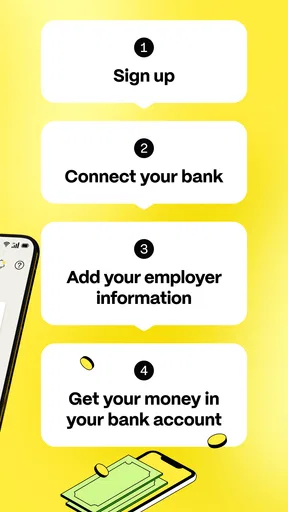
EarnIn is a financial app designed to give eligible users early access to part of their earned wages before their regular payday. After connecting supported employment and bank information, the app may estimate available earnings and let users request a transfer. It is not a traditional payday loan, but availability, limits, verification, and transfer options depend on the user’s circumstances.
How does EarnIn work, and who can use it?
EarnIn generally requires users to receive regular paychecks, work at an eligible employer, have a consistent pay schedule, and use a supported bank account. The app verifies employment and earnings through information or connections provided during setup. Eligibility is not guaranteed, and users may be asked for additional verification. Features and availability can also vary by location, employer, account history, and other requirements.
How much money can I access with EarnIn?
The amount available through EarnIn is based on factors such as verified earnings, pay frequency, account activity, and previous use of the service. New users may receive a lower limit while the app evaluates their account. The amount shown in the app is not necessarily the same for every payday, and users should review the current limit, transfer timing, and any applicable costs before confirming a request.
Does EarnIn charge fees or interest?
EarnIn is commonly promoted as offering access to earned wages without mandatory interest charges, but some features may involve optional tips, expedited-transfer charges, or other conditions. Costs can depend on the transfer method and the choices made inside the app. Before using it, carefully review the confirmation screen and current terms so you understand whether a fee applies and when the money will arrive.
Is EarnIn safe to use, and what should I consider before downloading it?
EarnIn may require sensitive information, including employment details, income data, identity information, and bank-account access, so users should download it only from an official app store and read its privacy and security policies. Early wage access can help with short-term cash flow, but it may also make future paychecks feel smaller. Use the service carefully, protect your login, and avoid relying on advances for recurring expenses.
